Some links in this post are referral links — if you sign up I may earn a small bonus, at no extra cost to you.
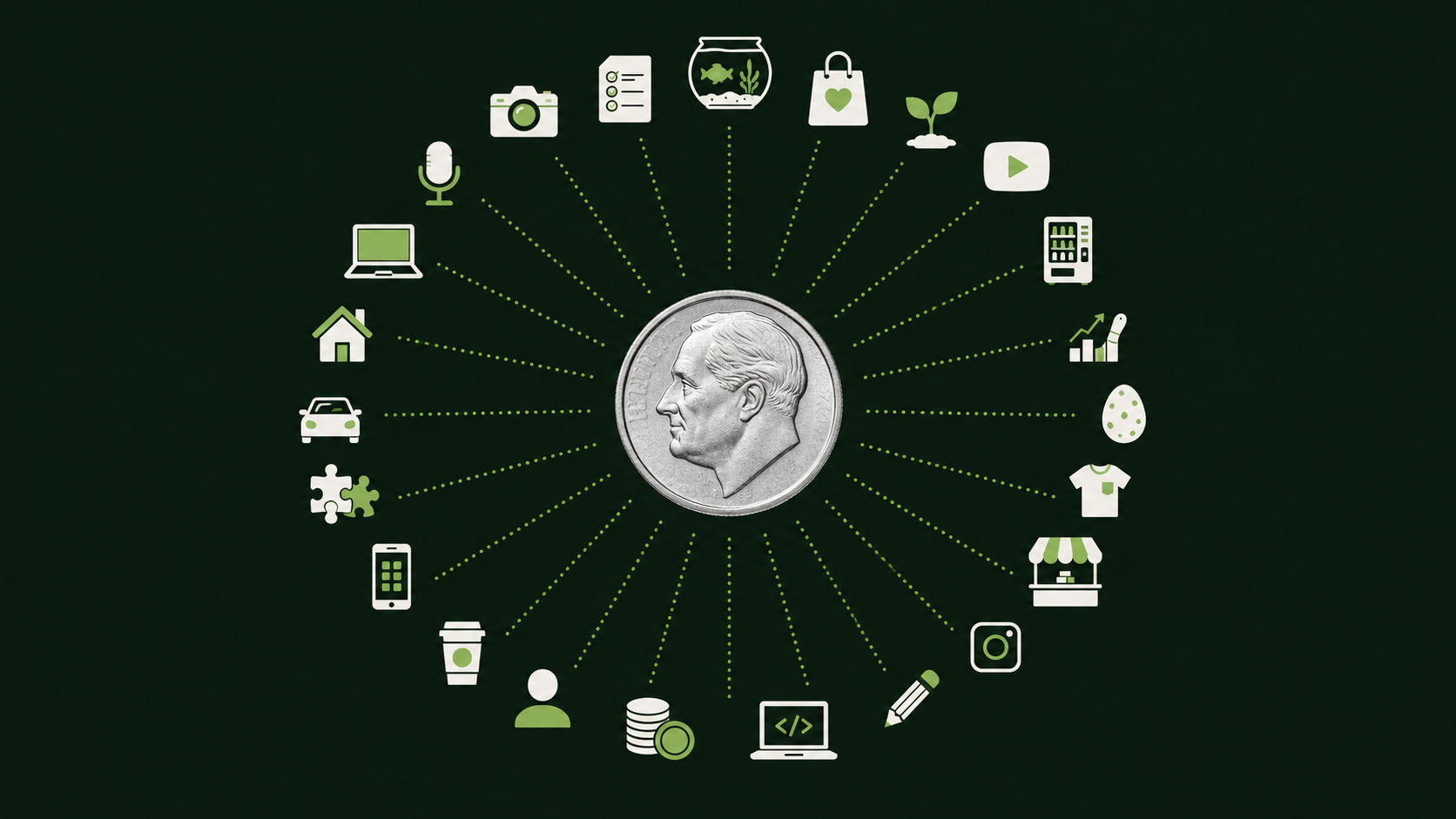
If you’ve read the origin post, you already know the idea: 24 income streams, earn one dime a day from each before I scale any of them. This is the full list. No cherry-picking, no hiding the weird ones — just the 24 things I’m actually building, in plain English, along with why each one made the cut.
Some of these are typical side-hustle staples. A few of them are homestead-specific and probably not for everyone. A couple of them are genuinely experimental. I’m not claiming this is the perfect list — I’m claiming it’s my list, and that it follows the rules: every stream on it has a first dime I can realistically earn within days, costs almost nothing to test, and has a ceiling worth aiming for eventually.
Here they all are.
The 24 Streams at a Glance
- Fish Tank Live Stream
- Surveys & Research Studies
- Etsy
- KDP (Self-Publishing)
- Blog
- YouTube
- Stock Dividends
- Vending Machines
- Patreon / Bioreactors
- Earthworms
- Rabbits
- Quail
- Aquaponics
- Flippa
- Merch (Print-on-Demand)
- Affiliate Marketing
- Microgreens
- Twitch Subscriptions
- Sponsored Content
- Rental Property / Storage Units
- Bill Reduction
- Seedling Starters
- Storj & Passive Apps
- Flea Market / Consignment
1. Fish Tank Live Stream
I already have the tank, so this one costs me essentially nothing to start. The idea is to stream my aquarium on YouTube and Twitch, let it run passively in the background, and earn through tips, channel memberships, and eventually ad revenue. Live streams keep a channel active without requiring me to edit video — one of the few ways to generate content while I’m at work or asleep. First dime target: a single YouTube Super Chat or tip. Everything else is upside.
2. Surveys & Research Studies
The first stream I actually started, and the fastest first-dime on the whole list. I’m running Prolific [referral link] as my daily baseline — it enforces a $8/hr minimum and has the lowest disqualification rate of any survey panel I’ve found. For higher-value sessions, I check Respondent.io and User Interviews, which pay $50–$200/hr for 30-minute video interviews. Branded Surveys [referral link] fills gaps. None of these are going to replace a paycheck, but they are real, reliable cash that doesn’t require owning anything.
3. Etsy
I want a digital product on Etsy that earns while I sleep. The appeal is obvious: upload a file once, sell it indefinitely, no shipping, no inventory. I’m starting with what I already know — printable planners, trackers, and templates that match the kind of thing I’d search for myself. The hard part isn’t making the product, it’s finding the keywords. I’ll be leaning on Etsy’s own autocomplete to learn what people are actually looking for before I publish anything.
4. KDP (Self-Publishing)
Kindle Direct Publishing lets you publish low-content books — journals, planners, trackers, activity books — to Amazon with no upfront cost. I’m not trying to write the next great American novel; I’m trying to get a quail-keeping journal or a homestead log book listed on Amazon and see if the dime arrives. The royalty rate is decent, and Amazon’s organic traffic is underrated as a free distribution channel. This one might take a few weeks to earn its first dime, but the effort per book is small once you know the format.
5. Blog
You’re on it. The blog’s job right now is to serve as a hub that ties all 24 streams together — the update posts link back here, the referral links live here, and eventually the traffic that finds me through search will fund a few of the other streams through affiliate commissions. Right now traffic is near zero. The strategy is to publish useful content, get it indexed, and let Google do the slow work. I’m not chasing ads (the payout floor is too high for where I am); I’m chasing the first referral click that turns into ten cents.
6. YouTube
Long-term, YouTube is probably the highest-ceiling thing on this list. The ad revenue on YouTube is real and recurring in a way that most platforms aren’t. Short-term, I’m not anywhere near monetization requirements, so the plan is to use it as a traffic source that feeds the blog and the live stream, and to build the kind of backlog that starts compounding views over time. YouTube Shorts from the fish tank stream are a low-effort way to stay active while the long-form library builds.
7. Stock Dividends
This one takes money to make money, which is why it’s in the middle of the list and not at the top. I’m looking at dividend ETFs like SCHD and VYM, which pay quarterly and reinvest automatically. The goal right now is just to get started — even a small position — so the compounding clock starts ticking. A single dime in dividends requires almost nothing invested; the point is to establish the habit and the account, not to retire on Q1 distributions.
8. Vending Machines
Vending machines have surprisingly low barriers to entry if you buy used and negotiate a good placement. The hard part isn’t the machine — it’s finding a high-foot-traffic location where the owner will let you put one. I’m scouting laundromats, car washes, and small offices locally. This one needs a real upfront cost so it’s not a fast first dime, but a single well-placed machine can produce passive income for years with minimal maintenance. It’s on the list because the ceiling is real.
9. Patreon / Bioreactors
This is the weird one on the list, and I know it. I’m genuinely interested in building small bioreactors — systems that grow algae or useful microbes for gardening and aquaponics. I figure if I document the builds and post about the process, a Patreon with a small monthly membership could fund the hobby and maybe more. The first dime here would be a single $1 patron. It’s experimental enough that I might swap it if it stays at zero, but it’s mine enough that I’m giving it a real try first.
10. Earthworms
A worm bin is cheap to start, runs mostly on food scraps, and produces two sellable things: worm castings (a premium fertilizer) and live worms (for fishing bait, composting, and reptile feed). I already have a bin going. The first dime target is a single bag of castings or a small cup of red wigglers sold locally or on Facebook Marketplace. This one is as close to true zero-input passive income as anything on the list, once the colony is established.
11. Rabbits
Rabbits are one of the fastest-reproducing livestock you can raise cheaply. Kits sell as pets, as meat, and as food for larger reptiles and birds of prey — there’s a market for all three. I’m starting small: one breeding pair, track the litters, calculate my actual cost per kit versus what the local market will pay. The dime arrives with the first sale. The homestead streams (rabbits, quail, earthworms, microgreens) are the ones that look strange on a side-hustle list but make a lot of sense if you already have the space and setup.
12. Quail
Coturnix quail are tiny, quiet, and legal in most backyards where chickens aren’t. They start laying eggs at six weeks and produce almost daily. The eggs sell well at farmers markets and to local chefs — quail eggs are considered a specialty item and command $4–$6 a dozen without much trouble. I’m tracking my cost per dozen (feed cost divided by egg count) against what the market will bear. First dime: first sold dozen, or the first farm-fresh egg sold directly.
13. Aquaponics
Aquaponics combines fish and plants in one system: fish waste feeds the plants, plants filter the water for the fish. It’s a real working setup and not as complicated as it sounds once it’s cycled. I can grow salad greens, herbs, or specialty plants that sell fast at local markets. I can also sell the fish when they’re big enough. The system ties into the fish tank live stream in a useful way — the same content that earns on YouTube can also document what I’m growing and selling locally.
14. Flippa
Flippa is a marketplace where people buy and sell websites, apps, and online businesses. The strategy I’m watching is micro-acquisitions: buying something small and already earning for a few hundred dollars, optimizing it slightly, and either holding it for monthly cash flow or flipping it for a profit. I’m not buying anything yet — first I’m learning to read listings without getting taken. The first dime from this stream will take longer than the others, but one good flip could be worth more than all the other streams combined in a single transaction.
15. Merch (Print-on-Demand)
Print-on-demand means I design a product, list it, and a third party prints and ships it when someone orders — no inventory, no upfront cost. I’m using Printify [referral link] and listing through Etsy. The designs will tie into the fish tank and homestead brand — “Fish Tank Dad”-style mugs and shirts are a real category with real buyers. The margin per item is modest, but the effort per sale after the initial design work is essentially zero.
16. Affiliate Marketing
This one is already threaded through several others on this list — any product I recommend and link with a referral code is affiliate marketing. But it deserves its own entry because the strategy matters: I’m only recommending things I actually use (fish tank gear, homestead supplies, the apps on this list), and I’m joining the affiliate programs for those specific products rather than slapping random links on everything. The first dime comes when someone clicks through and makes a purchase. This is the stream most directly powered by the blog’s traffic.
17. Microgreens
Microgreens are crops that take 7–14 days from seed to harvest and sell for $20–$40 a tray at farmers markets and to local restaurants. The startup cost is low (seeds, growing trays, a grow light), the turnaround is fast, and demand is steady because restaurants want consistent local supply. My plan is to start with one crop I already know (sunflower or pea shoots), prove out the unit economics, and expand from there. First dime: first tray sold.
18. Twitch Subscriptions
Twitch Affiliate status unlocks subscriptions, which start at $4.99/month. The fish tank stream will be running on Twitch anyway — the incremental effort to set up Twitch sub tiers and perks is small. The viewers who find me there and want to support the stream directly can subscribe; that’s ten cents per subscription (roughly). Reaching Affiliate on Twitch requires 50 followers and a modest average viewership, which is a realistic early goal. This and the YouTube live stream overlap heavily, so the content effort is shared.
19. Sponsored Content
Once the blog or YouTube channel has any real audience at all, there are small brands in the aquarium and homestead space that pay for honest reviews, mentions, or demos. I’m not there yet, but I’m building the media kit now so the pitch is ready when it’s time to send it. The first dime from this stream will arrive later than most — you need something to show brands before they pay — but when it does it tends to arrive in larger chunks than the daily earners.
20. Rental Property / Storage Units
This one is aspirational at this stage of the experiment, and I’m honest about that. I don’t own rental property. What I’m doing right now is learning the market — looking at local storage unit rental prices, researching what a small self-storage facility actually costs to operate, and understanding the numbers. The point of keeping it on the list is to stay oriented toward the ceiling, not just the floor. If another stream earns fast and frees up capital, I want to know where it could go.
21. Bill Reduction
Technically this isn’t earning income — it’s stopping the bleed. But a dollar saved is a dollar I don’t have to earn, and the math is the same. I’m systematically going through recurring bills (phone, internet, insurance, subscriptions), calling providers to negotiate, and canceling anything I don’t actively use. A $10/month reduction compounded over the year is $120 back in my pocket. That’s real money, and the “first dime” here is the first successful negotiation. It’s on the list because it works and it costs nothing but a phone call. I already knocked $40 off my internet bill — see: Rocket Cut My Internet Bill by $40 a Month — Was It Worth the $192 Fee?
22. Seedling Starters
In spring, garden centers sell seedlings for $3–$6 per flat. I can grow those same seedlings myself for cents and sell them at local markets or on Facebook Marketplace before they ever hit a garden center shelf. This is a seasonal stream, but it’s a fast one — seeds to sellable plants in a few weeks, and buyers are easy to find when people are putting in their gardens. First dime: first flat sold. The aquaponics setup helps here since I have the infrastructure and the lights.
23. Storj & Passive Apps
Storj [referral link] lets you rent out unused hard drive space to a decentralized cloud storage network and earn crypto in return. If you have a machine that’s always on with unused disk space, this earns passively in the background without any ongoing effort. I’m stacking it with bandwidth-sharing apps like Grass [referral link] and EarnApp, which pay to use your idle internet connection. The key is making sure the bandwidth apps don’t starve Storj’s uploads. Combined, these are the closest thing to truly set-it-and-forget-it income on the list — assuming you have always-on hardware to run them.
24. Flea Market / Consignment
The most old-fashioned entry on the list, and honestly one of the fastest first dimes available to anyone who owns anything. I’m identifying items I own but don’t use, pricing them realistically, and selling them at local flea markets or consignment shops. This isn’t a scalable business — eventually I’ll run out of my own stuff to sell — but as a way to learn how to price, pitch, and close a face-to-face sale, it’s the best possible low-stakes training ground. And it funds the other streams while I’m still in the testing phase.
What Comes Next
Every one of these streams has its own “first dollar” post coming — the moment I earn a real ten cents from it, I’ll document what I actually did, what I tried that didn’t work, and whether the stream earns the right to stay on the board and get scaled. That’s the rule.
If you’re building your own list, you don’t need 24. You need however many you can actually run in parallel without letting all of them go stale. The number matters less than the discipline: earn the first dime from each one before you optimize anything. The rest figures itself out.
A dime can make a difference. Here are my 24.